

MILITARY ∙ MEDICAL ∙ AEROSPACE ∙ ELECTRONICS ∙ SEMICONDUCTOR ∙ CONSTRUCTION
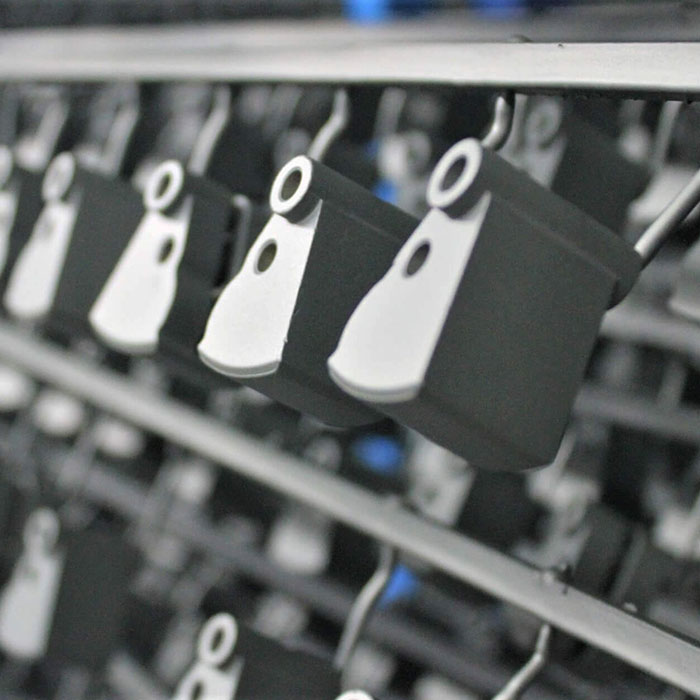
In situations where oils and greases don’t work well, dry film lubricants do something very useful. Instead of leaving behind a wet, slippery layer, they create a thin solid coating on the surface of a part. That dry coating reduces friction, helps control wear, and keeps moving parts from rubbing directly against each other as harshly.
That is why dry film lubricants are often used in demanding industrial settings. They can perform well where liquid lubricants might attract dust, drip, break down, or simply create too much mess.
THEY LEAVE A DRY, LOW FRICTION COATING
The basic idea is fairly simple. A dry film lubricant is applied to a surface and then cured so it bonds into place. It leaves behind a thin film that contains lubricating solids after it dries. The solids may be molybdenum disulfide, graphite, or PTFE, depending on the product and how it will be used.
When two coated or contacting surfaces move against each other, that film helps reduce the friction between them. Instead of raw metal dragging directly on raw metal, the dry film acts as a kind of protective layer in between. Less friction usually means less heat, less wear, and smoother operation.
THEY WORK DIFFERENTLY FROM OIL AND GREASE
This is what makes dry film lubricants interesting. Traditional lubricants work by creating a fluid barrier. Dry film lubricants work by changing the surface itself. Once cured, the lubricating layer stays in place as a bonded coating rather than a wet substance that can run, splatter, or collect grime.
That makes them especially useful in places where cleanliness matters or where maintenance access is difficult. They can also be a smart choice in environments involving dust, high loads, temperature swings, or intermittent motion.
SURFACE PREPARATION MATTERS
A dry film lubricant is only as good as the way it is applied. Surface preparation is a big part of performance. The part usually needs to be cleaned and prepared so the coating can bond properly. The coating may not stick the way it should if the surface is dirty, oily, or not ready.
WHY INDUSTRIES USE THEM
Dry film lubricants are often chosen because they solve problems wet lubricants cannot solve as neatly. They can reduce wear on parts that slide, rotate, or operate under load. They can also help where relubrication is inconvenient or where excess oil and grease would create contamination.
In practical terms, they are often used to improve reliability, extend part life, and support smoother operation in systems that need a clean, controlled, low friction surface.
IT IS REALLY ABOUT CONTROL
That may be the best way to think about dry film lubricants. They are not just there to make something slippery. They are there to control friction in a predictable way without the drawbacks of a wet lubricant. For the right application, that can make a major difference in both performance and maintenance.
LET US HELP!
If you want to learn whether a dry film lubricant is the right solution for your parts, process, or production environment, contact Performance Coating. The right coating can help reduce friction, improve wear resistance, and support more reliable long term performance.
REFERENCES
Performance Coating
https://www.performancecoating.com/
DuPont MOLYKOTE, Dry Film Lubricant Coatings
https://www.dupont.com/molykote/coating.html
DuPont MOLYKOTE Anti Friction Coatings Brochure
https://www.dupont.com/content/dam/dupont/amer/us/en/Molykote/public/documents/en/DIGITAL_EN_MOLYKOTE_AFC_Selection_Guide_03-1096-01-AGP0523_17103.pdf
NASA, Solid Lubrication Fundamentals and Applications
https://ntrs.nasa.gov/api/citations/20010017158/downloads/20010017158.pdf
NASA, Process Specification for Dry Film Lubricant Application
https://www.nasa.gov/wp-content/uploads/2023/03/prc-8001-current.pdf
NASA, Solid Lubricants and Coatings for Extreme Environments
https://ntrs.nasa.gov/api/citations/20070010580/downloads/20070010580.pdf