

MILITARY ∙ MEDICAL ∙ AEROSPACE ∙ ELECTRONICS ∙ SEMICONDUCTOR ∙ CONSTRUCTION
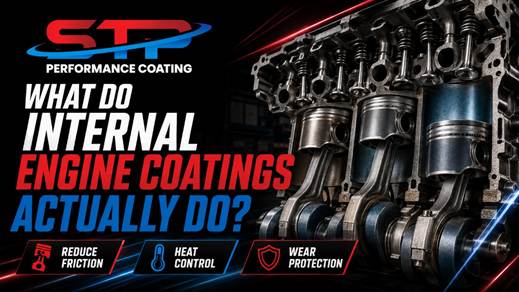
Internal engine coatings are sometimes described as though one product is sprayed onto every moving part. In practice, engine builders use different coatings for different jobs. One coating may slow heat transfer, another may reduce friction, and another may help a component release heat more effectively.
The value comes from matching the coating to the surface and the problem. It does not come from coating every part simply because the engine is apart.
Thermal Barriers Protect Hot Surfaces
A ceramic thermal barrier is commonly applied to piston crowns, combustion chambers, valve faces and selected turbocharger surfaces. Its purpose is to reduce the amount of combustion heat entering the underlying metal.
Keeping heat away from a piston crown can help the part cope with demanding conditions. A barrier may also distribute temperature more evenly across the coated surface. This can be useful in racing, turbocharged, supercharged or nitrous applications where cylinder pressure and heat are higher than in ordinary driving.
A thermal barrier is not a substitute for correct fuel delivery, ignition timing or cooling. Detonation can still damage a coated piston. The engine must be tuned for its intended load.
Dry Film Lubricants Address Friction and Wear
Piston skirts, pin bores, bearings, camshafts, lifters and other loaded surfaces can receive a dry film lubricant. These coatings contain solid lubricating material and are applied in a very thin layer.
The coating provides another level of protection when the normal oil film is limited, such as during a cold start or a brief loss of lubrication. On piston skirts, it can reduce scuffing as the piston changes direction within the cylinder. On bearings and valve train parts, it may reduce friction and wear at heavily loaded contact points.
Clearances still need to be established by the engine builder. Coating cannot correct a distorted bore, damaged journal or incorrect machining.
Heat Dispersants Work in the Opposite Direction
Not every engine surface should retain heat. Valve springs, intake manifolds, oil pans and other components may benefit from releasing heat more quickly.
A thermal dispersant increases the ability of the coated surface to radiate heat. Performance Coatings also blends lubricating agents into its dispersant, making dirt and residue less likely to grip the part. The result can be a component that sheds heat more evenly and is easier to keep clean.
This illustrates why choosing the right coating matters. A thermal barrier and a thermal dispersant perform different jobs, even though both are part of heat management.
Coatings Can Be Combined on One Piston
A performance piston may receive more than one treatment. The crown can be coated with a ceramic barrier to limit heat transfer. The skirt and pin areas can receive dry film lubricant to reduce friction and scuffing. Performance Coatings can also treat the underside to manage heat and reduce oil cling.
Each surface is considered separately. The crown faces combustion, while the skirt runs against the cylinder wall and depends on lubrication. Applying the same material everywhere would not address those different conditions.
Plan Coating Work During the Engine Build
Internal coatings are easiest to arrange while an engine is already disassembled. The parts must be clean, separated and ready for inspection. Parts should be fully disassembled according to shop requirements. Bearings, valves, gears and other components should be labeled so the engine builder can return them to the correct positions.
Discuss the intended fuel, power adder, operating temperature and vehicle use before choosing treatments. A drag engine, endurance car, towing diesel and restored street engine do not place identical demands on their parts.
The coating shop and engine builder should also agree on dimensions and masked areas before work begins.
Discuss Your Engine Parts With Performance Coatings
Performance Coatings Inc. applies ceramic thermal barriers, dry film lubricants and thermal dispersants to pistons, bearings, valves, springs, intake manifolds, turbochargers, oil pumps and valve train parts. Customers may deliver components to the Auburn, Washington, shop or arrange shipment after reviewing preparation requirements. Call 253 735 1919 to discuss which internal engine coatings suit your parts and how they should be prepared.
References
https://www.performancecoatings.com/internal-coating
https://www.performancecoatings.com/ceramic-coating
https://swaintech.com/race-coatings/race-coating-descriptions/coated-bearings/
https://swaintech.com/sport-compact-project-nissan-engine-build/
https://www.calicocoatings.com/company/coating-faqs/
https://www.calicocoatings.com/news/the-science-behind-the-coatings/